A concrete driveway typically costs less upfront and needs less ongoing maintenance than pavers, while pavers offer easier spot repairs and more design flexibility at a higher initial price. For most Wellington homeowners on a budget, concrete is the practical choice; pavers suit those prioritising kerb appeal and pattern customisation.
Choosing between a concrete driveway and pavers usually comes down to budget, how much maintenance you're prepared to do, and how important a specific look is to you. Both surfaces perform well across Wellington properties when installed properly, but they behave quite differently once they're in the ground, especially when it comes to repairs and ground movement. Here's how they actually compare.
What's the Difference Between a Concrete Driveway and Pavers?
A concrete driveway is poured as one continuous slab, or a series of large sections separated by control joints, creating a single, seamless surface. Pavers are individual concrete, brick, or stone units laid over a compacted base and bedding layer, held in place by friction and edge restraints rather than being bonded together. That structural difference is what drives most of the practical differences between the two.
Concrete Driveway vs Pavers: Quick Comparison
| Factor | Concrete Driveway | Pavers |
|---|---|---|
| Upfront cost | Lower | Higher |
| Lifespan | Decades, with occasional resealing | Decades, with occasional relevelling |
| Repairs | Usually cut-and-repour or resurfacing | Individual units lifted and replaced |
| Maintenance | Low | Low–medium |
| Design flexibility | Moderate (finish options) | High (pattern, colour, shape) |
Which Is Cheaper: Concrete or Pavers in Wellington?
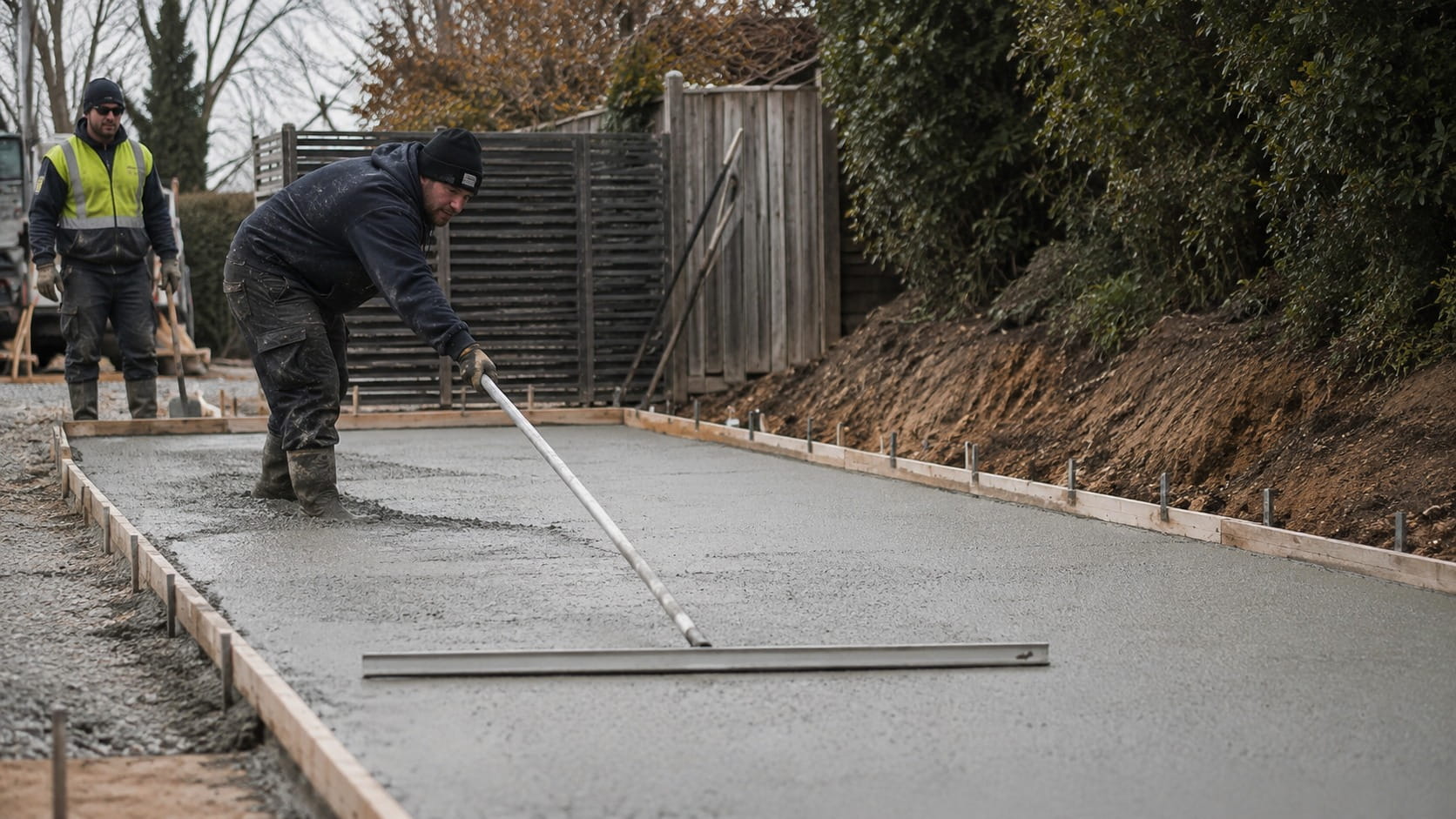
A poured concrete driveway is generally the more affordable option upfront, since it involves one pour rather than laying, cutting, and compacting hundreds of individual units by hand. Pavers cost more to install due to the labour involved, though the exact gap depends on the paver style and pattern chosen. For a detailed look at what drives concrete driveway pricing specifically, see our Wellington concrete driveway cost guide.
Which Lasts Longer, Concrete or Pavers?
Both surfaces can last decades when installed on a well-prepared base. Concrete tends to develop cracks over time as the slab ages or the ground beneath it shifts, though a single continuous crack is mostly cosmetic rather than structural. Pavers can shift or settle unevenly if the base wasn't compacted properly, but because they're individual units, minor settling is often easier to notice and correct early before it becomes a bigger problem.
How Do Repairs Compare Between Concrete and Pavers?
This is where pavers have a real advantage: a cracked or stained paver can be lifted out and replaced individually without disturbing the rest of the driveway. A damaged section of concrete, on the other hand, usually needs to be cut out and repoured, or repaired using crack repair or resurfacing techniques, since it's one continuous slab rather than separate pieces.
Which Option Handles Wellington's Weather and Ground Movement Better?
Wellington's clay-heavy soils and seasonal ground movement can affect both surfaces if the base isn't built correctly. Concrete relies on proper reinforcing and control joints to manage this movement without cracking excessively. Pavers have a natural advantage here since the joints between units allow for small amounts of movement and flex without visible damage, which is one reason pavers are sometimes preferred on sites with known ground movement or drainage challenges.
Which Adds More Kerb Appeal and Resale Value?
Both can look excellent when installed well. Pavers offer more pattern, colour, and shape options out of the box, which appeals to homeowners after a distinctive, high-end look. Concrete can match much of this with an exposed aggregate or stamped finish rather than a plain slab, closing much of the visual gap at a lower cost than full paving.
How Do Installation Timelines Compare?
A concrete driveway pour is usually quicker overall, since it's one continuous job followed by curing time, typically a few days from site prep to a driveway ready for light use. Paver installation takes longer per square metre because each unit is laid, cut, and compacted by hand, though pavers can often be walked on immediately after laying since there's no curing period to wait out. For larger driveways, this timeline difference becomes more noticeable.
Can You Combine Concrete and Pavers on the Same Property?
Absolutely, and many Wellington properties do exactly this. A common combination is a concrete driveway for the main vehicle area, paired with pavers for a garden path, patio, or entryway where design flexibility matters more than durability under vehicle loads. This lets you manage the budget by concentrating cost where it has the most visual impact, rather than paving the entire property at the higher per-square-metre rate.
How Do Concrete and Pavers Compare for Drainage?
Well-built concrete driveways are sloped and finished with control joints to shed water quickly, while pavers can be laid with permeable joints or bedding that allows some water to drain through the surface itself rather than running off entirely. Both approaches work, but if managing surface water on a challenging site is a priority, it's worth discussing directly with your contractor so the drainage plan matches the finish you choose.
Do Concrete and Pavers Need Council Consent in Wellington?
In most cases, a straightforward residential driveway replacement using either concrete or pavers doesn't need separate resource consent, though this can depend on stormwater management, impervious surface limits, and how close the work is to a boundary or the road. We'll flag anything that needs council sign-off as part of the quoting process, so there are no surprises once work is underway.
So Which Should You Choose: Concrete or Pavers?
If you want the most cost-effective, lowest-maintenance option and don't mind a plain or lightly textured finish, a concrete driveway is usually the better fit. If design flexibility and easy spot repairs matter more to you than upfront cost, pavers are worth the investment. Either way, the result depends heavily on getting the base preparation and drainage right, which matters more to long-term performance than the surface material itself. Get in touch and we'll talk through which option suits your site.